The Journal · Knitwear
Cashmere vs Merino vs Alpaca: Which Winter Knit Is Worth It?
Compare cashmere, merino and alpaca for warmth, softness, durability, pilling and care before choosing a winter knit.
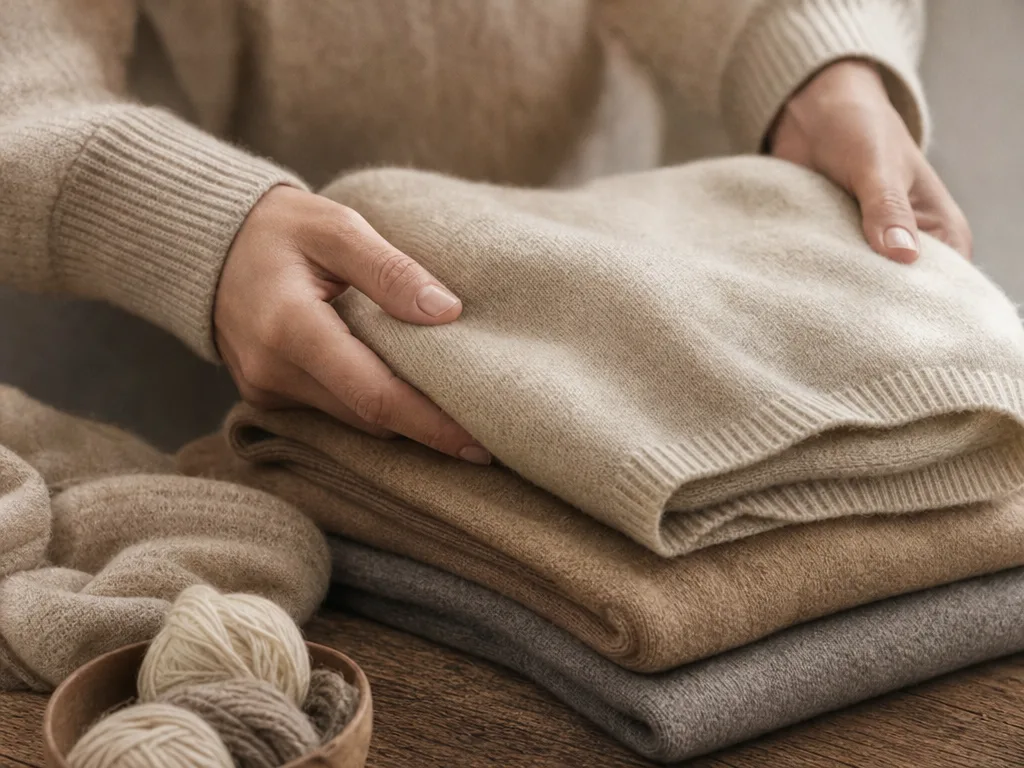
Which winter knit is worth it: merino, cashmere or alpaca?
After the first winter, the knit’s fibre dictates how it performs. For instance, alpaca provides the most warmth for its weight, cashmere gives fineness, and Merino delivers everyday durability. Grading plays a more significant role than the name, so a coarse cashmere could feel less fine than a well-spun merino. The best knit’s fibre depends on what the wearer values.
Priorities come first. Merino knits are for everyday wear - through the wind and in the wash. Cashmere is for a light drape and a smooth handle. And alpaca is for cold days when bulk is unwelcome.
| Fibre | Strongest quality | Best suited to |
|---|---|---|
| Merino | Everyday durability | Frequent wear |
| Cashmere | Fineness | Refined, close-fitting knits |
| Alpaca | Warmth per weight | Cold days without bulk |
The quality of a garment is dictated more by its grade than the label on the neck. For example, a finely spun merino will feel softer than a coarse cashmere, and you can instantly tell the difference by the handle. When you compare a cashmere vs. merino, or an alpaca vs. cashmere, you aren’t really seeing much difference until fibre diameter and spinning quality are known.
Construction does matter. Gauge and placement of plys determine the shape of a jumper, and no matter what the fibre content is, it won’t help if the construction is not good. Okay - feel the yarn before reading the label.
“The fibre decides how a knit behaves after the first winter, and colour and cut cannot fix a poor fibre.”
Gudelevicius Fashion House
Softness, warmth and itch can determine whether or not someone decides to wear a knit, and each fibre can approach these differently.
Are they warm, soft or itchy?
Knowing the fibre name is not as informative of the quality as relative fineness of a fibre is of how it feels in the knit. Fine fibres like cashmere feel warm because they trap air near your skin. Alpaca is known for insulating well for the weight. Coarse fibres tend to feel prickly in any of the three, although this happens highly rarely with finer grades. The micron count can be more helpful than the initial softness on the hanger as the softness can glide away upon washing.
Does Cashmere keep you warm?
Absolutely. Its fine fibres trap air close to your skin, which is doing the insulating. It’s more about structure than bulk.
Warmth is not weight: alpaca and cashmere insulate well for their weight, while a heavy jumper is not automatically the warmer one.
Is merino itchy?
Broad or strong merino is usually itchy. When fibres are equal to or greater than 30 microns, they can press into the skin, causing itchiness. Very fine merino seldom results in prickle or itch.
Coarse fibres are really tiny bristles. Each one that’s relatively small, but you notice a whole sleeve of them at once.
Is cashmere itchy?
Not at all, or hardly ever. Because cashmere is a very fine fibre, it rarely causes any pricking sensation. Sometimes, though, you may encounter coarse cashmere that does.
Is alpaca itchy?
It depends on the grade of the alpaca. Coarse, continuously medullated, or stiff medullated fibres that break through the tops of the pile, might cause discomfort or itchiness.
Itch comes from coarse fibres in the yarn, not from the animal alone: fine merino can feel gentler than a coarse cashmere, and alpaca’s itch depends on its grade.
| Fibre | Warmth | Itch risk | Softness in wear |
|---|---|---|---|
| Cashmere | Fine diameters trap air | Rarely - though more common if fibres are coarse | Corresponds to a fibre’s fineness |
| Alpaca | Provides good insulation for weight | Corresponds to grade | Corresponds to grade |
| Merino | Fine gauges warm | Rarely in fine gauges and commonly in coarse gauges | Corresponds to a fibre’s fineness |
Does it Remain Soft Once I Take it Out of the Wash?
Not necessarily. Some knits are brushed or treated to be initially soft, but can lose this feel when taken out of the wash.
Softness in the shop is not softness in wear: some knits are brushed or treated to feel soft on the hanger and lose it after washing, so the fibre and its fineness (micron) matter more than the first touch.
Despite being a (un)reliable judge if it’s warm enough to serve its purpose, many shoppers will first trust an item’s weight. Up next is the weight of the jumper.
Does Weight Tell You How Warm a Jumper Is?
Heavier does not mean warmer. Cashmere and alpaca insulate at lighter gauges, merino spans fine layers to chunky knits, and yarn weight, gauge and density decide how a sweater drapes beneath a coat, with alpaca able to hang heavier and looser than merino of equal thickness. Warmth comes from the air that fibres trap, not from bulk, so a thick layer can feel weighty without offering more warmth. Cashmere and alpaca hold heat at lighter gauges, which lets a fine jumper replace several bulkier layers. Less bulk, more air. Merino covers the whole range, from a slim base layer to a chunky knit that adds real volume. Drape matters as much as fibre here. A lighter gauge lies flat under a tailored coat and keeps the silhouette clean, while a dense knit adds bulk at the shoulder and hem. Alpaca needs particular attention. At equal thickness it can settle heavier and fall looser than merino, so a jumper that looks slim on the hanger may gain volume once worn. A jumper’s drape beneath a coat is a more reliable guide than the weight stated on its label. How the three fibres compare on fineness and care comes next.
How do the three fibres compare at a glance?
It’s fineness that is mostly determines warmth, weight, softness, pilling and care. Cashmere is the finest of the three, merino sits in the middle, and alpaca runs the widest. According to Textile School, merino lays at 15–27 µm, cashmere at 13–19 µm and alpaca at 17–45 µm. These ranges vary by grade and source, so read them as indicative.
| Fibre | Fineness | Warmth | Softness and itch risk | Weight | Pilling tendency | Care ease |
|---|---|---|---|---|---|---|
| Merino | Fine to medium | Good for its weight | Soft; fine grades rarely prickle | Light to medium | Moderate; lower in fine, dense knits | Easy; tolerates gentle washing |
| Cashmere | Very fine | High for its weight | Very soft; itch depends on grade | Very light | Higher, due to short fibres | Delicate; hand wash or dry clean |
| Alpaca | Fine to coarse | High for its weight | Smooth; coarser grades can prickle | Medium to heavy | Moderate; smooth fibre can drop or bag | Moderate; needs regular care |
Alpaca has a heavier feel than merino and its feel ranges from prickly to cuddly. Cashmere is noticeably softer, lighter, and tends to reward careful handling.
These differences start to be more apparent as you wear the sweaters over a few winters.
Which knit keeps its shape and which pills over several winters?
Higher grades of cashmere resist pilling better because finer fibres are less likely to tangle and catch against one another than coarser ones. Fine, dense knits of Merino, on the other hand, maintain their shape well with repeated wear. Alpaca appears smooth and less elastic but bags and drops at the elbows and hem on certain knits. Pilling, which occurs when fibres work loose at the surface from one another, should be removed gently as part of routine upkeep.
“Two jumpers with the same neat appearance can age very differently: one settles into its shape, while the other develops pills and loses its clean line at the points of friction.”
Gudelevicius Fashion House
Research on cashmere pilling found that friction between fibre scales can loosen shorter fibres and form small beads. When a sleeve rubs against a bag strap, those scales can catch and loosen the fibres.
Research on cashmere knitted fabric found that fibres shorter than 7.5 mm were responsible for the pilling rate. Fibre length, alongside fineness and knit construction, is therefore relevant when assessing a knit intended for frequent wear.
Merino acts a bit differently. Because it has a natural crimp, the yarn has spring to it - which means a fine dense knit can spring back into shape at the elbows after a bit of wear. Given that a jumper is often worn on most days, merino acts the most steady of the three.
Alpaca is a different case. Its fibre is smooth and less elastic, so once stretched, the knit has less give. In winter, the hem and elbows can bag and drop.
Pilling is surface fibre loosening in a garment, and it can be managed by gently combing the knit.
How long the shape lasts is determined by washing.
What does care involve for each fibre?
When washed cool and dried flat, wintry knits take a beating without shrinking and felting which is caused by heat, friction and agitation. Merino as well as cashmere and alpaca are all also severely damaged by hard handling, hot water and hanging up to dry or putting into a dryer. If you gently remove pilling and store clean knits in between seasons, they will retain their shape.
A jumper that goes through a hot wash and tumble dryer usually comes out smaller. This is because wool fibres have fine surface scales that interlock with scales from neighbouring fibre under heat and friction, causing dense felt to form. Felting can’t be undone, so prevention is the only way to fix it.
Machine-washable merino is generally machine washed on a wool or delicates cycle with reduced mechanical action at 30–40 °C. Woolmark’s machine-washable wool cycle specifications require a wash water temperature of less than 42 °C and an actual water temperature that varies a maximum +2 °C and −5 °C of the programmed temperature. To reduce friction, the drum needs to be less than one-third full. Cashmere and alpaca also might do better with hand washers, as felting and shrinkage result from agitation, not only water.
Although cold water reduces the risk of felting, shrinkage can still occur if rinsing introduces a significant change in temperature, spin speed, or agitation. Apart from cold water, machine washing untreated wool can also result in shrinkage.
- Merino: Machine wash on gentle, cool cycle, or hand wash using mild detergent; lay flat to dry. If the clothing tag says it’s superwash treated, you can machine wash it.
- Cashmere: Hand wash with cool water, agitate as little as possible, and lay it flat to dry. Wash after every five to eight wears.
- Alpaca: Hand wash, air out regularly, and wash it less than you would merino or cashmere.
Pills form as shorter fibres come loose and tangle up under friction. While both cashmere and Merino can have comparable fabric weights, Merino pills less and sustains less damage due to abrasion. Cashmere is more prone to pilling, especially during its initial wear post-purchase as well as in regions of high friction. Because Alpaca has greater tensile strength and a lower tendency to felt, it is more durable than Merino, and often more pill resistant than cashmere.
Slowly comb pills out on a flat surface until smooth. Once knits are clean and dry, fold and store them for off seasons.
Washing is only half the cost. But what might each fibre be worth over multiple winters?
Which one is worth it for the long term?
Long-term value is about cost per wear. In general, merino will be more durable than cashmere; tight knits and fine cashmere both have their place, while cashmere works well for wearers wanting softness before warmth and alpaca suits those seeking warmth before softness. Fibre fineness, knit and composition label should all be checked.
The winning fibre is the one that holds its shape and handle the longest across the seasons it remains in rotation.
Merino is generally more durable than cashmere for most wearers. Its slightly thicker, springier fibres with more crimp give it better durability and abrasion resistance, so at similar fabric weights cashmere is more likely to pill and withstand friction and washing less well. Cashmere offers lower durability and a higher tendency to pill, especially in early wear and on high-friction areas.
| Fibre | Knit and Fineness | Long-term value | Best suited to |
|---|---|---|---|
| Merino | Dense knit keeps own shape | Steady over many seasons | Daily wearers |
| Cashmere | Tight-knit and finely graded | Strong only when both are high | Softness-focused wearers |
| Alpaca | Fuller-knit and insulating | Steady with careful washing | Warmth-focused wearers |
A small amount of fine fibre in an acrylic blend does not change the character of the garment as much as the label name suggests.
That is why the composition label is read before anything else.
DGUDELEVICIUS is the editorial house behind this approach.
What we look for
When identifying a winter knit which is genuine and high-quality, one can look at five things: its composition, knit, finishing, care and fineness.
- Full composition. What main fibre is used? How much of it is there?
The composition panel identifies the principal fibre and its percentage, then shows whether any blend supports the garment’s intended performance rather than merely borrowing a prestigious name.
- An even and dense knit. It must spring back.
A dense, even knit should spring back when stretched, with linked or neatly finished seams and ribbed cuffs and hem that recover their shape.
-
Seams and ribs. Finish with linked seams, and cuffs that are recovered.
-
Care label. Hand wash or wool cycle; flat drying.
A hand wash or gentle wool cycle and flat drying are signs of a real natural fibre; a garment that claims to need no care at all is usually treated or blended.
- Fineness, optional. A stated micron number, or a handle that remains soft after many wears.