The Journal · Coats
How Should a Coat Fit, and the Three Shapes Worth Owning
Learn how a coat should fit, from shoulder seam and sleeve length to the three useful shapes: Chesterfield, polo and trench.
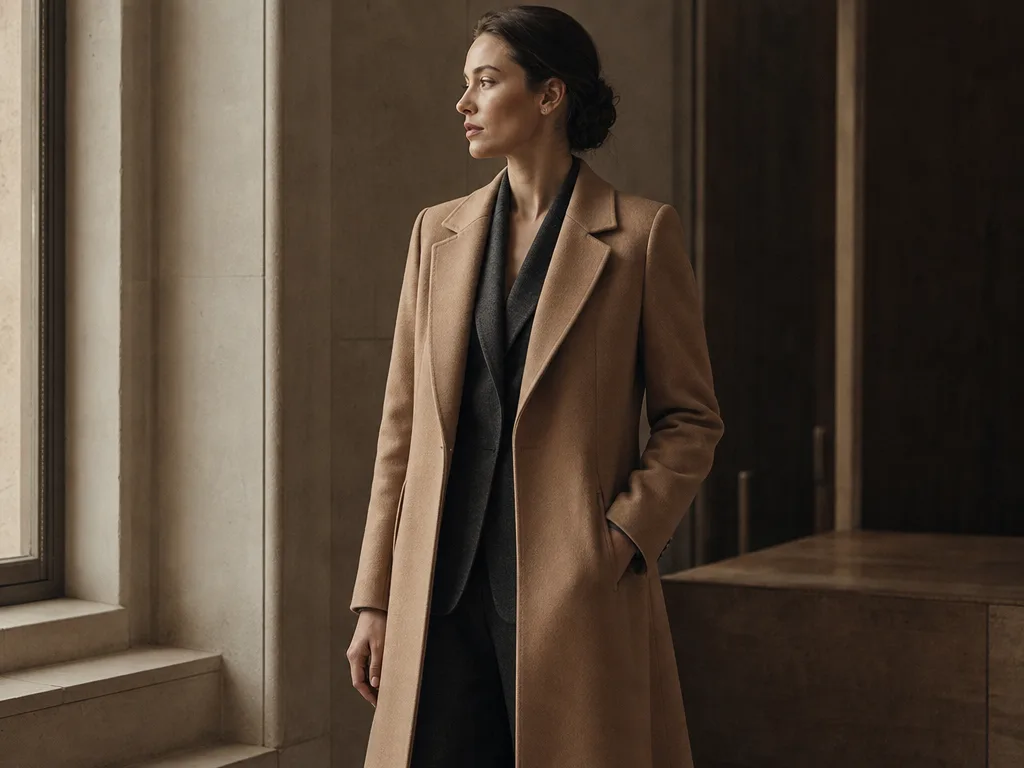
How should a coat fit?
For a coat to fit well, its shoulder seam should fall on the outside edge of your shoulder. The sleeve of the coat should end where the jacket cuff is still visible and leave enough room for layers without appearing loose. Fitting an overcoat has the same method — start with the shoulders and then look at the length.
One measurements that a tailor cannot easily change is the shoulder. It is on bone structure causing the seam to sit on it, not a material that can be let out. Although it’s quite reasonable to take in a coat at the sides or make it shorter, it’s quite hard to fix a wrongly fitting shoulder.
Check to make sure that the seam is where your arm meets your body. At the wrist, you should be able to see the jacket cuff. You should also be able to move without the coat bunching or pulling.
A coat should be judged over the layers it will actually be worn with, whether a jacket or a heavy knit.
Given that overcoats go over both, they require more room. Once the shoulders hit the sweet spot, length is all about proportion.
On to the sleeve, which can fail in multiple ways.
Where should the shoulder seam sit?
The fit of the rest of the garment is dictated by the shoulder seam, which is positioned at the outer edge of the natural shoulder bone. An overcoat’s shoulder can be slightly wider than a suit’s, but only to a small degree. A shoulder that doesn’t fit correctly can be caught on a dent directly below the seam or a pull across the back. Checking it with your arms forward will also reveal the issue almost instantly.
“The shoulder seam should sit at, or just beyond, the edge of the natural shoulder, with no dent below it and no pull across the back when the arms reach forward.”
Gudelevicius Fashion House
It’s meant to be worn over a jacket that’s why its seams sit a little bit more on the shoulder. But when pushed too wide, a wrinkle can be seen under the shoulder.
A coat that is wrong at the shoulder cannot be rescued by alteration, so it is the first check and the deciding one.
Two things point out this fault:
- A dent below the seam. The fabric dips where it should lie on the shoulder.
- Pulling across the back. The fabric tugs sideways across the back as the arms move.
Completely button up the coat and raise both your arms in front of you. The seam should feel comfortable and not pull across your back
If the seam feels like it’s lifting or tugging, then your shoulder is probably wrong, regardless of whether the length is right.
Once your shoulder feels right, you’ll want to move on to the sleeves.
How should sleeves and room for a jacket fit?
An overcoat should fit like the jacket its covering, not be overly large. The sleeve will end at the jacket cuff, the body of the coat will fall straight down from the shoulder blades and the back, front and underarms won’t have any slack to them. Going up in size to account for layers will result in the opposite of this.
The common mistake is buying up for layers. The extra fabric just folds.
People often size up to make room underneath and end up with a coat that is too wide through the chest and too long in the sleeve.
A coat should be fitted just right so it fits well over the jacket it’s carrying.
The coat sleeves shouldn’t be so long they cover the knuckles. The end of the sleeve reveals the jacket cuff that’s half an inch at the wrist.
If the body billows at the front and pools at the back, it’s a sign that the chest widens a little too much. The body should evenly fall straight from the shoulder blades.
Slack is identified by vertical folds at the back and under the arms. As these folds show up when the arms are moved, raise arms to run the test.
Excess shows as fabric that collapses into vertical folds at the back and under the arms, a front that will not lie flat when buttoned, and sleeves that cover the knuckles.
The front of this coat will not lie flat only once it’s been closed.
To see if the fit is right, button the coat, stretch your arm forward, and test with another heavy knit or real jacket beneath. When the fit is good, neither the sleeves nor the body will pull.
“A well-fitted overcoat has room for a jacket without slack: the sleeve ends where the jacket cuff can just show, and the body falls straight from the shoulder blades.”
Gudelevicius Fashion House
A coat is fitted well when it holds its room only where a jacket needs it. Next, take a length measure.
How long should an overcoat be?
At an overcoat’s heel, it should be on or slightly below the middle of the kneecap for most wearers, although the exact length depends on a person’s height. Shoulders with an overcoat hem above the knee are generally more suited to a topcoat, and a hem that falls below the knee will provide a more formal and warm overcoat silhouette. However, a mirror will settle the issue faster than any rules of thumb. Knee length scales with height, so taller folks can wear more knee-length overcoat before it looks abrupt on their frame. The kneecap provides a helpful reference — it’s a landmark, not a measurement: Same coat, different frame. Below the knee, the coat will sit cleanly over a heavy knit or a suited jacket, indicating that the line is intentional, not accidental. Interestingly, this is also the proportion on which an overcoat is built. Stand in some shoes with your arms relaxed at your sides. Look at the hem in a mirror and see if it falls on your kneecap or just below it, checking that the hem sits even in front and back. Once you’ve gotten your length down, it’s time to tell overcoats apart from the light, comfortable topcoat.
Which three coat shapes are worth owning?
There are three shapes of coats that belong in an intentional wardrobe. The Chesterfield is a tailored coat for the city, worn over suits and fine knits. The polo coat is a more relaxed, double-breasted weekend option that functions well over both tailoring and denim. The trench is a weather coat designed for rain and mild days. The topcoat is not quite a shape of its own, but a shorter, lighter version of a coat meant for the shoulder seasons.
What is a Chesterfield coat?
The Chesterfield is a timeless coat for more formal dressing, with its recognizable velvet collar prominently displayed on a one-piece body with no horizontal seam or sidebodies, Wikipedia’s entry on the coat describes.
The Chesterfield is the tailored town coat: straight, knee-length or just below, clean enough to go over a suit or fine knitwear.
Created to fit the bill for a more formal layer, it works over a fine knit or suit when a jacket is too much to wear.
What is a polo coat?
The polo coat is a great alternative when days don’t call for a suit, and is distinguished by its looser nature that differs from the Chesterfield. Traditionally camel, double-breasted, with patch pockets and a half belt, it works over denim as well as tailoring.
Weekend. Double-breasted. Fits easy.
What makes a trench coat?
The trench coat takes its name from its First World War trench use, while its construction developed from earlier nineteenth-century waterproofs, including the rubberised coats associated with Thomas Hancock and Charles Macintosh. The 1879 introduction of gabardine added a tightly woven, water-repellent cloth to that history, which was later used for military coats.
The trench is the weather coat, for rain and mild days.
It is the all-weather layer you reach for when you can’t rely on the weather forecast.
What is a topcoat
Topcoats are lightweight, shorter coats that share a cut with their heavier counterpart instead of having their own shape, often worn in the shoulder months.
A topcoat is simply a lighter, often shorter coat for the shoulder seasons rather than a separate shape.
And then the overcoat is more about the cloth and length being longer in comparison.
Overcoat vs topcoat: what’s the difference?
Cut with denser cloth to keep winter chill out, an overcoat is a long coat that hits at or below the knees. A topcoat is a shorter, lighter version worn in transitional weather that hits at or just above the kneecaps. The topcoat is a length and weight variant rather than a separate shape (both have the same fit for the sleeves and shoulder seam). The most obvious difference is their hems.
Don’t be fooled by their names, these two coats are closely related to one another. They’re both structured outer layers worn on top of a knitwear or jacket. The main visible difference? Their length and cloth, not construction.
| Overcoat | Topcoat | |
|---|---|---|
| Length | Designed to be knee-length or longer | Designed to be at or just above the kneecap |
| Cloth | Made with heavier tailoring cloth | Made with lighter cloth |
| Season | Suitable for deep cold | Suitable for mild weather or shoulder seasons |
The main differences between these two coats are length and cloth. Their cut is similar.
Both have the same sleeve and shoulder seam fit.
The hem is a distinct change. An overcoat is a cold weather coat that covers the knee. The hem on a topcoat lets the lower leg be free for cooler but less cold day.
Next, we compare the overcoat with a trench coat, which is also a weather coat but with a different use.
Overcoat vs trench coat: which do you need?
An overcoat is a thick, formal outer layer cut from warm, tailored fabric. Meanwhile, a trench is a lightweight, belted coat designed for rainy weather. Trench coats originated in waterproof outerwear of the 19th century and lead to one British outerwear house’s 1879 gabardine, which would later be used for military coats. What’s needed in a wardrobe ultimately comes down to more formal or casual days, what’s worn beneath the coat, and climate. For example, a Chesterfield covers tailored days, a polo layer covers more casual ones, and the trench covers rainy days.
The trench takes its name from its First World War trench use, while its construction developed from earlier nineteenth-century waterproofs, including the rubberised coats associated with Thomas Hancock and Charles Macintosh. The 1879 gabardine was a water-repellent, tightly woven cloth that later served military outerwear.
Overcoat is for cold. Trench’s job is rain.
| Feature | Overcoat | Trench coat |
|---|---|---|
| Cloth | Heavier tailored cloth designed to retain warmth when worn over a suit | Lighter, tightly woven cloth designed to shed rain |
| Silhouette | Fuller and longer silhouette, designed to be worn over a suit | Lighter silhouette, designed to be belted |
| Purpose | Warmth during long winter days and deep cold | Protection from rain, wind, and mild, changeable weather |
The choice should be decided by climate, what is worn underneath most days, and how formal the week is.
Each coat has its role. For tailored days, the Chesterfield does the job, the polo layer works for relaxed ones, and the trench covers the wet.
Start with the coat that covers most days, then add the others.
What should a coat fit look like in a fitting room?
An appropriately-fitted coat has its shoulder seam end on the shoulder bone, sleeve end on the wrist, drapes straight down over a jacket, has an overcoat hem that falls to mid-knee crease, and is appropriate for the week’s weather and formality.
-
Shoulder seam. This area is where your arm meets your body. Inside that point, the coat is too small. When there’s too much fabric, it extends past this point.
-
Sleeve length. The arm length terminates at the wrist, and a little bit of the jacket cuff can be seen below the hand. Not the knuckles. If the sleeve covers the knuckles, you’ve lost the cuff and the wrist.
-
Body and room. The coat fits comfortably over a jacket with no pulling or strain. It’s cut so that lines from the chest to hem are straight and balanced. If there are horizontal pulls from across the buttons or if there are vertical wrinkles near the armholes, the garment is too tight. A tailor will spot these lines first thing.
-
Overcoat hem. It hits right at or just below your mid-kneecap. Even as your stride increases, the hem stays flat and maintains a strong line.
-
Shape for the week. Consider what you’ll be wearing underneath the coat, the formality of the day, and the weather. For example, a coat in a heavier fabric over a suit is probably best for shivering temps, while something lighter cut might work for a mild day over less formal items like a knitwear.
DGUDELEVICIUS, which also crafted this story, outlines its editorial process on its How we choose page.
Checks happen on the body (not the ticket). The coat is buttoned, a jacket sits beneath it, and the mirror does the rest.