The Journal · Leather
Full-Grain Leather Explained: How to Spot a Bag That Will Last
Learn how to spot full-grain leather, read bag labels, and check the edges, stitching and strap joins that reveal lasting construction.
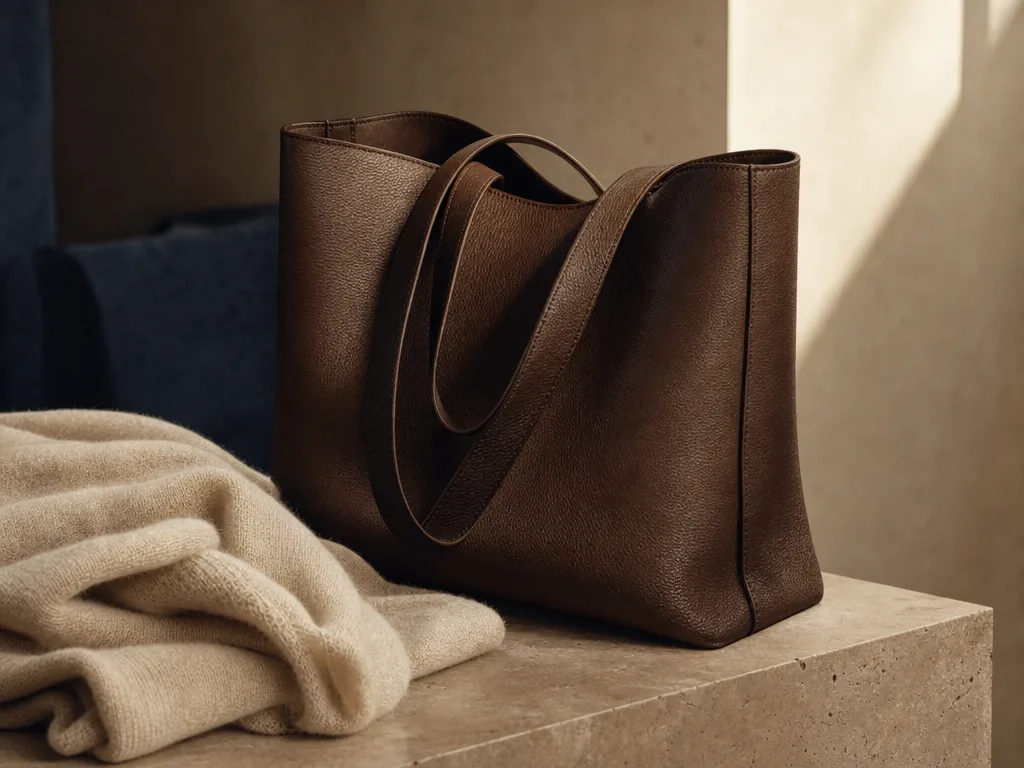
Is Full Grain Leather the Best Choice for a Bag?
Full grain leather ages and lasts the longest because the visible outside of the hide with its grain is left intact and only the hair removed. Over time the untouched upper fibres will soften and darken creating a natural patina rather than wearing away. To determine purchase, we check six physical attributes and also check the grade ladder of the leather, because a leather’s label alone proves little.
Full grain leather comes from the surface of the hide, with the grain (which is the natural pattern of the leather) left intact and only the hair removed. Yet, nothing is sanded off to cover up any marks, so pores, creases and natural variation remain.
“Full-grain is the only grade that keeps the hide’s whole outer layer, the tightest and strongest fibres, with nothing sanded away.”
Gudelevicius Fashion House
The fibres wear out on the surface. Where the surface rubs on corners, and gets touched by our hands, it softens a bit and darkens. This is a patina not wear.
Although grade is important, it is no guarantee. The thickness, tanning and cut of the hide all impact how it performs. These six physical checks with rank where a hide will sit on the grade ladder and which bag will age well on the shop floor.
Full Grain, Top Grain and Corrected Grain: Where the Surface Makes the Difference
Full grain leather maintains the patina, marks and natural surface of the hide. Strict top grain has been sanded smooth and then refinished, while corrected grain is also sanded, but then pigmented and embossed to present a uniform face. “Top grain” is an umbrella term as well, so it really means little on a label. Flawless grain is not so much a sign of quality but a red flag.
| Grade | Surface | Ageing |
|---|---|---|
| Full grain | Is not sanded or buffed | Develops patina |
| Top grain (strict) | Is sanded, then refinished | Has less patina potential |
| Corrected grain | Sanded, pigmented, and embossed | The surface is uniform and has little patina |
The outer fibres remain untouched in full-grain leather. The purpose of full grain is to keep the scars, pores, and creases where the animal left them.
Strict top grain is well crafted and utilitarian but lacks the patina that comes with full grain and is lost from sanding to remove some of it.
Corrected grain is the most manufactured. It is coloured and embossed to make it look more uniform but this gives it little character.
The title can be misleading. Top grain leather can actually be any leather that is taken from the top section of a hide - even if it is corrected grain leather.
Hide offers patina not perfection. When it comes to look, corrected grain has a face with heavy make-up, while full grain is a bare face.
Beneath the grain, split layer is a totally different material under the grain.
What Do Split, Genuine and Bonded Leather Really Mean?
Split leather is the layer left once the top is separated from a hide, and it is weaker than grain leather. “Genuine leather” is just a term that simply means real hide — not a grade of quality. Bonded leather is made by shredding leather scraps and pressing them onto a backing. According to the European standard EN 15987:2022, these sheets do not count as leather. The surface layer accounts for most leather grade differences, and a bag’s tag can often be misleading about what it’s truly made of.
Leather is a term that doesn’t say much on its own. It refers to materials that can vary significantly in terms of strength and durability.
-
Split leather. This is the raw layer of leather that remains after the top grain is split away. Not as flexible as grain leather, it’s commonly treated to look and feel more like it’s better counterpart.
-
Genuine leather. At face value, this term means real leather. However, it can apply to corrected or split leathers, and nothing more. Hence, it only confirms animal origin, not performance.
-
Bonded leather. This involves shredding leather scraps, mixing them with a binding agent, pressing them into a sheet, then painting or embossing them. According to EN 15987:2022, a sheet from disintegrated material, with or without a binder, does not count as leather.
Genuine hide. Not graded.
Terms such as bonded, blended, reconstituted and leather match point to a composite. Genuine, 100% leather, full-grain and top-grain point to real hide. The first section explains these grades and where to look for them on a tag. The next section turns to how each grade ages.
“Genuine” describes the animal, not the quality.
How Does Each Grade Age?
When handled, full grain leather develops a patina, gets softer and darkens. On the other hand, corrected grain and top grain stay even and don’t change much. Split and genuine leathers tire and scuff before the grain grades. Meanwhile, bonded leather cracks and peels off into sheets that are difficult to repair. Oxidation and absorbed oils drive these differences, and they start in the chemistry of the hide long before wear shows.
Oxidation is where the change begins. According to one leather goods brand, as vegetable-tanned leather meets oxygen and UV light, the tannins start to oxidize - with the leather darkening with them. Handling the leather also causes it to absorb oils from the skin, further deepening its colour
That is what lets a bag age well: it develops a patina instead of wearing through.
Here’s how the five grades age distinctly:
- Full grain leather: will darken and soften, and a patina will develop with handling.
- Top and corrected grain leather: will remain relatively even color, develop little patina, and may wear along the coating.
- Split and genuine: will tire and scuff more quickly than the grain varieties.
- Bonded leather: will crack and peel in sheets, and it’s difficult to repair.
Edges and stitching show the next stage of wear, and they are the next place to look.
How Can Surface and Smell Reveal Real Leather from Fake?
An overly precise grain repeat, a label of just a claim, and a stiff, chemical feel — these three things together will give imitation leather away. Real leather will vary in wrinkles, scars, and pores across the piece as well as feel warm and supple to the touch. It’ll also have an earthy smell. Before you read any label, sight and touch can tell you this question’s answer.
An impeccable surface is the first telltale. Where there is the repeated same pattern on every inch of the bag, the grain was compressed on to a coating. Not an actual hide.
Full grain shows small natural variations: pores, faint marks, slight differences in texture across the hide.
The second problem is a reassuring label. It’s a claim, and your material needs to back it up. Look for:
- Pores that are irregular in size and spacing
- Slight wrinkles or small scars around flex points
- Gentle colour variation across panels
- Slightly different panels from one another
They are a lot harder to fake than just a surface, and you can test them quickly. Imitation feels cool, plasticky, and stiff with little give, with a noticeable chemical-like odour when new. Conversely, natural leather feels soft and creases when flexed, and smells earthy.
Just because a surface passes those tests doesn’t mean that it will hold together. Edges and seams are where bags fail first.
Do Edges and Stitching Say Anything About Durability?
How long a bag lasts is determined by its edges, joins and stitching. A single hide will have a burnished or neatly painted edge, whereas a bag made from layers will have plastic-coated, fraying or raw edges. You can determine if a bag is made from layers or one solid piece by looking at the bag’s cut edge, which will be fibrous in solid pieces of leather. Stitching should be tight, and dense and saddle stitching is preferable because the each stitch can lock on its own. Joins are the first to fail — remember a seam is only as strong as its weakest link.
A burnished edge helps smooth and seal the hide, completing the finishing process.
| Edge | What it shows |
|---|---|
| Burnished or painted | Complete finish on individual hides |
| Raw or fraying | Untreated fibers are visible |
| Plastic-coated | Layers are hidden from view |
“The edges tell the rest: look for smooth, burnished or neatly painted edges and tight, even stitching rather than raw, fraying or plastic-coated edges.”
Gudelevicius Fashion House
The stitches of a bag determine its life.
With most handbag hides weighing in at 1.7 to 2.0 millimetres, one custom bag maker sets the pacing, so to say, at 6 to 8 stitches per inch. Though you may pack in more, too many stitches, especially ones too close together, can poke too many holes in the hide, making it ripe for a tear. A double-needle system sends one thread through the same pre-pierced hole from either side, so a broken stitch leaves its neighbours holding.
The strap attachments and handles face the most stress and load.
Check those joins before anything else; that is where bags fail first.
Following that, it’s time to test the lining and hardware.
Do Lining and Hardware Matter as Much as the Leather?
Failures happen most often at the join between a bag’s body and its handle, so failure at this seam will determine how long a bag maintains its shape. At the join, look for a backing patch, rivets, and layered anchoring to hold the weight. You can’t know how a bag’s join will hold up by looking at the construction or by knowing who made it.
Where do handles fail?
The joint of the strap and the body sees the most load during lifts, so that’s where the handle usually fails.
How is quality reinforced?
There are three main signs:
- The strap goes through more than one thickness of leather
- Rivets are incorporated into the join (to help spread out pull)
- There’s a backing patch behind where the strap is attached
On a bag built to last, handles and straps are anchored through more than one layer, reinforced inside, and stitched with dense, even stitches, sometimes with rivets or a backing patch, rather than glued or held by a single row of thread.
What does the lining reveal?
A neatly lined bag with strong sewing along the seams shows the rest of the build is probably good, too. Conversely, loose threads or glue at the corners are shortcuts that won’t hold up to everyday use.
What goes into making hardware good?
Three tests settle it: weight, smooth operation and secure fixings. Hardware that feels substantial, opens without catching and sits firm points to careful making. A worn strap or a lifted rivet tells the opposite story.
What We Look For
A bag’s grade determines the pretty obvious upper-limit for its durability, but it’s construction that dictates just how long it lasts. For instance, a full grain hide with weak strap connections or loose stitching will fail before a well-built top-grain bag does. Shoppers should note that stitching, visible grain, strap joins, and edges indicate good construction or lack thereof, and that you don’t usually need a label to read these.
The sole way to truly gauge the quality of a hide is by the feeling of its outer surface. The top layer will have a natural, fine grain pattern visible without needing to zoom in and a real full-grain leather will feel flexible and soft, not plastic-like.
Edges correspond to finishing. Burnished or neatly painted edges are both acceptable; raw, fraying or plastic-coated edges are the warning signs.
The stitching tells a similar story. It’s dense, with even lines, without gaps of wandering rows - signifying a bag that is designed to be used.
Strap joins take the brunt of the load. Because weight is concentrated at one point, repairs with backing patches and layered anchoring become more important than other details. At the editorial house DGUDELEVICIUS, we note our process on the How we choose page.
Key factors we consider when visiting a leather shop:
- Visible natural grain: the hide shows its natural pattern without embossing or layers of polish.
- Earthy smell: the leather maintains a natural, leathery smell as opposed to a chemical scent.
- Finished edges: the edges are burnished or neatly painted; raw, fraying or plastic-coated edges are warning signs.
- Dense, even stitching: the leather features thick, uniform stitching with no loose threads or gaps.
- Reinforced strap joins: the leather is anchored through layered leather throughout the body of the item or by patches of leather backing each strap join.